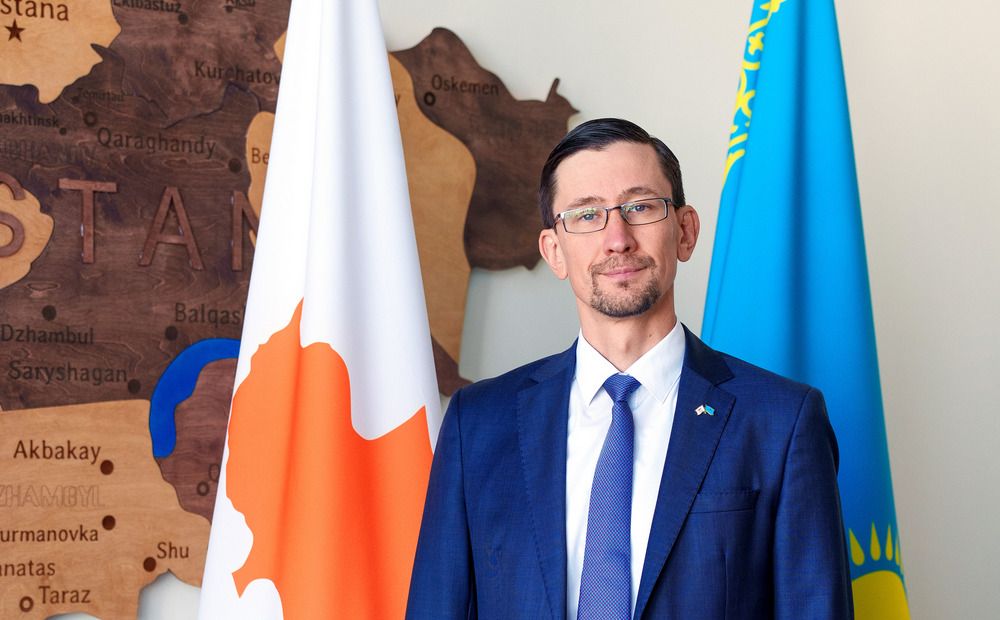
In 2025, Kazakhstan opened its embassy in Cyprus, thereby elevating bilateral relations to an entirely new level. Today, an active political dialogue is developing between the two countries, business cooperation is being strengthened, investment initiatives are taking shape, and the introduction of direct air connectivity is expected. In this interview, the Ambassador of Kazakhstan to the Republic of Cyprus, Nikolay Zhumakanov, explains how foreign investors are protected in Kazakhstan, which Kazakh sectors are the most promising for Cypriot business, what makes the Middle Corridor unique, and why new opportunities for cooperation are now emerging between Astana and Nicosia, and between the private sectors in Kazakhstan and Cyprus.
– Your Excellency, how would you assess the current state of economic relations between Cyprus and Kazakhstan?
– Trade turnover between our countries is currently modest, unstable, and varies from year to year. In certain years, there are one-off deliveries involving significant amounts, but overall trade volumes remain below one million US dollars (USD 625,000). It is therefore difficult to speak of well-developed trade relations at this stage, although clear prospects are evident.
The situation in the investment sphere is quite different. According to statistics since 2005, the total volume of Cypriot investments in Kazakhstan amounts to USD 5.3 billion, while Kazakh investments in Cyprus are approximately USD 2.0 billion. These are substantial figures that reflect the scale of economic interaction. At the same time, Cyprus often acts as an international business hub, with many investments channelled through Cypriot companies that use the island as a convenient jurisdiction for capital structuring.
– Which sectors does Kazakhstan consider the most promising for investors, including Cypriot ones?
– Today, Kazakhstan is interested in attracting investment across virtually all sectors of the economy. We see particular potential in the production of high value-added goods, IT, the financial sector, tourism, transport and logistics solutions, and agriculture.
Infrastructure development is currently progressing actively in Kazakhstan. This includes dry ports on the border with China, new railway crossings, port complexes on the Caspian Sea, and motorways. Of particular importance in this context is the development of the Trans-Caspian International Transport Route, which is taking shape as a key corridor linking China, Central Asia, the Caucasus, and Europe.
Agriculture represents a major standalone sector. The diversity of climatic zones allows for the development of both crop production and livestock farming. Kazakhstan is attractive not only because of its domestic market of 20 million people, but also due to access to significantly larger markets – Russia, Uzbekistan, Kyrgyzstan, and China – including through unified customs and trade regimes within the Eurasian space.
 – How are the interests of foreign investors protected in Kazakhstan? What mechanisms are in place to minimise their risks?
– Kazakhstan has established a comprehensive system for the protection of investors. Its foundation is the Entrepreneurial Code. At present, a draft Agreement on the Mutual Protection of Investments between Cyprus and Kazakhstan is at the approval stage, while a Convention on the Avoidance of Double Taxation is in force.
For large-scale projects, individual investment agreements are signed. If the volume of investment exceeds USD 60 million, the agreement is signed on behalf of the Government, and the state becomes a direct guarantor, ensuring the stability of conditions and commitments. For investments of a smaller scale, there is also a graduated system of incentives.
In addition, a number of specialised institutions operate in Kazakhstan:
– Kazakh Invest acts as a one-stop shop, serving as a single point of entry and contact, and accompanies projects from the initial stage through to the signing of contracts.
– The Foreign Investors’ Council under the President serves as a platform for major strategic projects.
– The Council for Attracting Investors (Investment Headquarters), chaired by the Prime Minister of the Republic of Kazakhstan, together with relevant structures at the ministerial level, provides tailored support for strategic and priority investment projects.
– A new Committee for the Protection of Investors’ Rights under the General Prosecutor’s Office, recently established by presidential instruction, considers disputes or misunderstandings should they arise.
Thus, Kazakhstan has developed a comprehensive system for the protection of investors. It is of fundamental importance to us that investors trust Kazakhstan and have no doubt about the state’s readiness to provide support at all stages of project implementation.
– If we speak about the economic potential of cooperation between the two countries, in which areas do you see the greatest growth?
– Much depends on logistics. With the formation of sustainable transport chains, trade turnover will be able to demonstrate steady growth. In this context, the launch of direct air connectivity, as well as the development of maritime transport schemes, could play a significant role.
At the same time, it is important to take into account the scale of the markets. For Kazakhstan, Cyprus represents a relatively small market, whereas for Cyprus, Kazakhstan, by contrast, is a large and capacious market. Cypriot companies do not always objectively possess production volumes sufficient to simultaneously meet the needs of the domestic market and those of Kazakhstan, with its population of around 20 million people.
At the same time, statistics on investment presence indicate a stable interest on the part of Cypriot business in Kazakhstan. As of 1 December 2025, 421 enterprises with the participation of Cypriot investors were registered in Kazakhstan, of which 344 continue their operational activities. This confirms the long-term and practice-oriented nature of economic cooperation.
Exports of certain Cypriot goods to Kazakhstan, or supplies of Kazakh products to Cyprus, are possible, but are likely to remain niche due to transport costs and production volumes in both countries. For Cypriot business, Kazakhstan may be of interest primarily as a gateway to a vast regional market.
Overall, we are ready to work with companies from all sectors. It is important to present Kazakhstan to them, give them the opportunity to assess its potential, and allow them to choose the most appropriate direction for their activities. The country offers favourable conditions and a transparent organisation of business processes, including the digitalisation of public services, the banking sector, company registration, and reporting.
– One of the key areas of development in the region is the Middle Corridor, also known as the Trans-Caspian route. What are its main features and what makes it unique?
– In essence, the Middle Corridor represents a modern analogue of the Great Silk Road. Historically, this route connected East and West, and today it is once again emerging as one of the most promising transport and logistics corridors. Its key advantage lies in the speed of cargo delivery. While maritime routes from China or Kazakhstan to European Union countries typically take 30–40 days on average, transit via the Middle Corridor takes approximately 10–12 days, even taking into account transshipment across the Caspian and Black Seas.
Over the past 15 years, Kazakhstan has invested substantial resources – around USD 35 billion – in the development of the corridor’s infrastructure, including the construction and modernisation of railways and roads, as well as port infrastructure. This includes the ports of Aktau and Kuryk on the Caspian Sea and a network of dry ports. Until recently, the Middle Corridor was viewed primarily as an alternative route; however, over the past five years, cargo volumes transported along this channel have demonstrated multiple-fold annual growth. As a result, the route has taken shape as one of the key logistics arteries of the region.
– Kazakhstan opened its embassy in Cyprus, stating that this step corresponded to its national interests. Cyprus is a friendly country, and the deepening of bilateral relations is entirely natural. How do you assess the situation and prospects now, one year after the opening of the embassy?
– Kazakhstan pursues a multi-vector foreign policy and seeks to maintain respectful relations with all countries. We enjoy good relations with Russia, China, the states of Central Asia, the European Union, the United States, Turkey, and many other partners.
Kazakhstan and Cyprus share many points of convergence on the international stage. Both countries are active within the framework of the United Nations, often support each other in elections to its bodies, and hold similar positions on key international issues. Last year, the Deputy Prime Minister – Minister of Foreign Affairs of the Republic of Kazakhstan paid an official visit to Cyprus. This visit was the first in the history of bilateral relations and marked an important milestone in the development of political dialogue between our two countries.
Cyprus is a valuable partner within the European Union. Its position and unique understanding of the region are particularly important in light of Cyprus’s current Presidency of the Council of the EU. In turn, Kazakhstan is a member of organisations to which Cyprus does not have direct access, such as the CIS (Commonwealth of Independent States), the SCO (Shanghai Cooperation Organisation), and the Organisation of Turkic States. This creates new channels for dialogue and cooperation.
 – What outcomes does Kazakhstan expect from Cyprus’ Presidency of the Council of the European Union?
– We regard this Presidency as an important opportunity to advance a number of priority initiatives. First and foremost, this concerns the agreement on visa facilitation between Kazakhstan and the European Union. Negotiations are already under way, and we hope that during Cyprus’ Presidency it will be possible to accelerate and, potentially, conclude this process. Visa facilitation would significantly strengthen business ties and people-to-people exchanges.
In addition, we expect further development of cooperation between the EU and Central Asia in the fields of economy, transport, energy, and digitalisation. Cyprus’ Presidency may give fresh momentum to these areas.
– How would you assess Kazakhstan’s relations with the European Union overall?
– Kazakhstan’s relations with the European Union are characterised by stability and substance. The EU remains Kazakhstan’s largest trading partner and the main source of foreign direct investment. In 2024, bilateral trade turnover exceeded USD 49 billion, while the gross inflow of foreign direct investment from EU countries since 2005 has amounted to approximately USD 200.7 billion, which represents around 48% of total FDI inflows.
The Enhanced Partnership and Cooperation Agreement, signed in December 2015, became the first legal instrument of its kind between the EU and a partner in Central Asia. It provides for cooperation across 29 key policy areas, including trade, investment, transport, energy, environment, education, and many others.
We continue to expand this cooperation – from trade and energy to sustainable development and the improvement of the business environment.
– The possibility of introducing direct flights between Kazakhstan and Cyprus is being discussed. At what stage is this issue now?
– The prospects are very encouraging. Both sides are showing strong interest. At present, passengers are required to travel with transfers; however, even under these conditions, the Embassy of Cyprus in Astana issues between 100 and 200 visas per month to Kazakh citizens. This clearly indicates genuine demand.
Direct flights would significantly simplify travel, increase tourist flows, and be beneficial for business. Kazakhstan, with a population of 20 million and a sustained interest in beach holidays, could become a new source of tourists for Cyprus. At the same time, Cypriot travellers would be able to discover Kazakhstan both as a summer and a winter destination.
– What tourism opportunities can Kazakhstan offer to travellers from Cyprus?
– Tourists have access to a wide range of attractions. In particular, there are ski resorts, including Shymbulak, located near Almaty and regarded as one of the leading ski resorts in the region. During the summer season, there are numerous hiking routes, mountain lakes, and natural landmarks, including Charyn Canyon and Lakes Kolsai and Kaindy.
Northern Kazakhstan is known for the Burabay resort area, with its forests and lakes. The eastern part of the country is characterised by picturesque mountain and taiga landscapes, while western Kazakhstan stands out for the unique scenery of Mangystau, including the Ustyurt Plateau and the Bozzhyra tract, renowned for its chalk formations and striking natural relief.
Alongside its natural attractions, Kazakhstan also boasts a rich cultural and historical heritage. A special place is occupied by Turkestan, home to the Mausoleum of Khoja Ahmed Yasawi, a UNESCO World Heritage Site, as well as other ancient cities and monuments of the Great Silk Road.
Those interested in contemporary architecture and urban development will find the capital, Astana, particularly appealing, with its futuristic appearance and bold architectural solutions.
We intend to actively promote tourist routes, develop cooperation with tour operators, and organise familiarisation trips for Cypriot agencies.
Interview by Natalia Kardash
Nikolay Zhumakanov is a career diplomat, he has extensive experience in international law, European affairs, and multilateral diplomacy.
Over the years, he has served in senior roles at the Ministry of Foreign Affairs of Kazakhstan, including as Director of the International Law Department, and has worked at the Embassy of Kazakhstan in Belgium, closely engaging with EU institutions. His professional background combines public service and corporate governance, providing a strong foundation for advancing Kazakhstan–Cyprus political, legal, and economic cooperation. Since January 2025, he has been Ambassador Extraordinary and Plenipotentiary of Kazakhstan to Cyprus.