

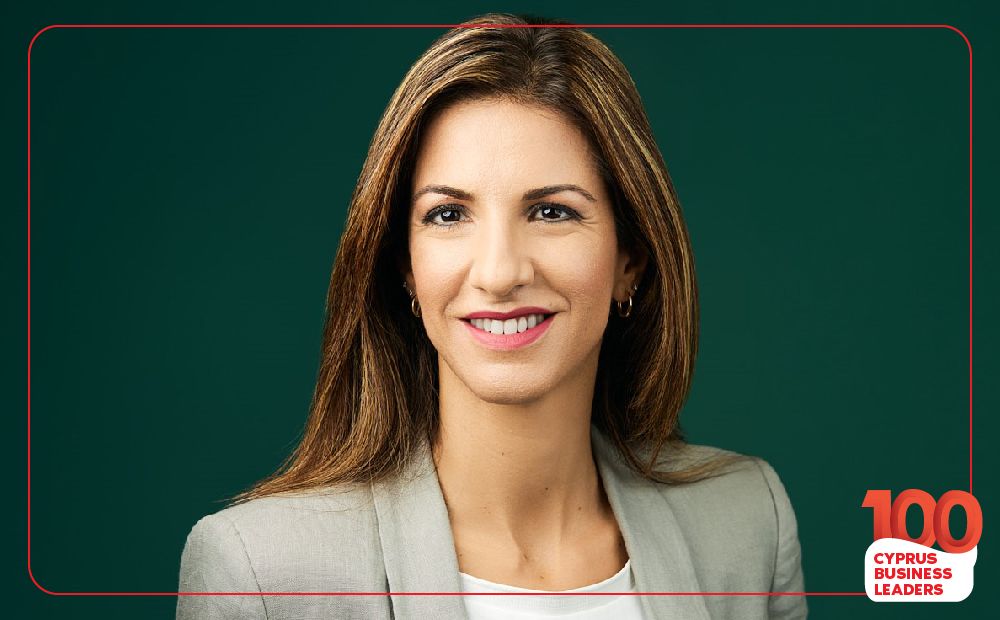
As the CEO of Unicars and a fourth-generation leader of one of Cyprus’ most established family groups, Christianna Diogenous navigates an evolving automotive landscape with a rare blend of instinct, structure and empathy. Her career spans consulting in London, a decade in FMCG and logistics, and a return to mobility during one of the industry’s most transformative periods. She leads with a strong sense of responsibility to her people and her legacy, yet with a distinctly modern, human approach. In this conversation, she reflects on leadership, culture, change and what it means to build something that lasts.
Your career spans consulting, FMCG distribution, logistics and once again, the automotive sector. Looking back, what inner compass guided your professional decisions through such different industries?
I have always relied on my instinct. It is something I trust deeply, and over the years it has guided most of my decisions. I usually sense quite clearly whether something is right for me, and then I validate that feeling by speaking to people around me whose judgement I value. But the final decision comes from within.
At the very beginning of my career, choosing to stay in London to work in consulting, rather than returning immediately to Cyprus, was about standing on my own professionally and gaining the experience of an international professional environment. That early independence shaped the confidence I carried back into the family business.
Eventually most of my career has been within our family group, thus another guiding force for my decisions has been the desire to honour and contribute to the legacy that began with my great grandfather and continued through my grandfather, my mother and my aunt. My brother and I grew up in that environment and were encouraged to understand the business at every level. So whenever I considered a move, the question was not simply what I preferred, but where my contribution would matter most.
This is why I agreed to move from Unicars to the FMCG business, even though I loved automotive. At the time, Consumer Goods felt less appealing and out of my comfort zone, but it was the right decision for the Group. Ironically, that experience became one of the most formative periods of my career, giving me a deep understanding of operations, change management and team dynamics. Years later, when I returned to Unicars, I was bringing back much more substance.
You stepped into the role of CEO at Unicars during a time when mobility, sustainability and customer expectations were shifting rapidly. What was the first change you felt compelled to make?
When I returned to Unicars, I felt that the company had lost part of its cultural identity. After the financial crisis, the organisation had naturally gone into defensive mode, but in doing so it had turned inward. Some of the unity and shared sense of purpose that had always characterised Unicars had become less visible over time.
The first priority was to rebuild that cultural foundation. Before we talked about technology or strategy, I wanted our people to reconnect with our values and with each other. I wanted to restore the feeling of one team with a common direction. That meant open conversations, clear alignment among the management team and a renewed focus on our people.
Then the pandemic arrived. Because we had already started modernising the culture and pushing towards digital transformation, the crisis accelerated our progress instead of stalling it. We launched the first online showroom in Cyprus, created digital customer journeys and kept people connected even when they were confined at home. The fact that customers continued to buy cars during lockdown strengthened our confidence internally. We realised that agility and alignment allow us to adapt quickly, even in extreme circumstances.
Many leaders speak about the moment they began to truly feel like a leader. Was there a turning point for you that shaped your understanding of responsibility and influence?
For me, leadership emerged gradually rather than through a single moment. It became clearer during the major restructuring of the FMCG business, which included mergers, a division into separate companies and significant operational change. I led those processes from start to finish.
What made me feel like a leader was not the complexity of the transactions, but the impact on people. When colleagues told me that the way the changes were handled made them feel respected, safe and valued, I understood the weight of responsibility a leader carries. People spend a huge part of their lives at work. If leaders do not acknowledge the human aspect of business decisions, then something fundamental is missing.
Our family group has survived through four generations because it has always prioritised people. That sense of responsibility deeply shaped my own approach to leadership.
Unicars represents some of the world’s most trusted automotive brands. How do you balance global standards with the cultural and market realities of Cyprus when making strategic decisions?
Balancing global direction with local relevance is one of the most interesting parts of the role. Global brands require consistency in values, positioning and visual identity. In the era of social media, it is important that a customer in Cyprus recognises the same Volkswagen or Audi they see elsewhere.
At the same time, Cyprus has its own geography, lifestyle and expectations. A purely global message often does not resonate. We look for creative ways to express brand values through a local perspective. One example was a campaign where we gave a car to a Cypriot photographer and asked him to photograph it wherever he felt inspired. The images were beautiful and recognisably Cypriot yet retained the premium look of the brand. People reacted strongly to seeing familiar landscapes presented in a fresh way.
Another project we are proud of is the Skoda 130th anniversary initiative with a young Cypriot cyclist who lived in his Skoda for 130 days while travelling across Europe to compete in races. His authentic, human journey deeply engaged the Cypriot audience and caught the eye of the Skoda global team, who featured his story and invited him to take-over the international WeLoveCycling Instagram account. This initiative even went on to win a Gold Award at the Skoda Marketing Summit - a powerful reminder that local creativity can complement the global brand in powerful ways.
Your involvement in the Motor and Electric Vehicles Importers Association places you at the centre of Cyprus’ transition to sustainable mobility. What do you see as the next realistic steps for the island?
Cyprus is naturally suited to electric mobility. We have short distances, plenty of sunshine and none of the extreme climate challenges that complicate electrification elsewhere. At Unicars, we committed early. Since 2019, e-mobility has been a central part of our strategy.
We invested first in our own readiness. We created high-voltage technician and awareness training programmes, established what I believe is still the only Battery Repair Centre in Cyprus and modernised our workshop infrastructure. In parallel, we built a public charging network in places where people already spend time. Today we have set up the largest publicly-accessible, privately-owned charging network.
In addition to our work at Unicars, as Vice President of the Motor and Electric Vehicles Importers Association, I am actively involved in promoting initiatives to the appropriate authorities and the wider public to help move Cyprus decisively towards more sustainable mobility.
Infrastructure alone is not enough. Incentives matter a great deal. Government subsidy schemes helped move the market, but they are coming to an end. We need a long-term national plan that includes tax benefits, support for corporate fleets and urban policies that encourage clean vehicles in congested areas.
Finally, above all, we need clean energy. The environmental benefits of electric vehicles are maximised when the electricity used to charge them comes from renewable sources. Cyprus has excellent potential for renewable energy and integrating that into e-mobility will make the whole system genuinely sustainable.
As Vice President of the Cyprus-Germany Business Association, you interact with two very different business cultures. What aspects of German business culture do you appreciate that Cyprus could adopt and vice versa?
From Germany, I particularly appreciate the emphasis on punctuality, directness and clarity. People say what they mean and get to the point. In Cyprus, we sometimes take longer to reach a conclusion. A bit more directness would improve efficiency and transparency.
From Cyprus, I think German colleagues appreciate our warmth and informality. Over the years I have seen a shift from strict formality to a more relaxed approach. Where German conferences once required full business attire, today smart-casual and trainers are perfectly acceptable. It reflects a broader change in the business world and a more human style of communication.
When the two cultures complement each other, the combination is very effective: German rigour with Cypriot openness.
You’ve managed diverse teams across very different industries. What did your early leadership years in FMCG teach you about building a healthy organisational culture that you still apply today?
The foundation of a healthy culture is honesty, integrity and trust. If people feel that you are transparent and fair, they are far more willing to engage, take responsibility and grow.
In practical terms, this means communicating clearly, especially during periods of change, and investing genuinely in people’s development. In Cyprus many companies are small, which limits the number of formal promotions available. Even so, leaders can find ways to help people progress by reshaping roles, offering greater responsibility, or enabling them to gain new skills. What matters is demonstrating that the organisation sees them and cares about their future.
I also believe strongly in authenticity. People respond better to leaders who show up as themselves rather than trying to fit some predefined model. Authenticity builds trust far more effectively than authority.
With your background in social psychology and executive education at INSEAD, how do you approach building teams that can handle complexity and long-term relationships?
Psychology gave me the mindset; INSEAD gave me the structure. Studying social psychology made me highly aware that people perceive situations differently and bring their own strengths and motivations.
That awareness helped me develop empathy and an ability to understand the other person’s perspective. It is essential for leadership, teamwork and negotiation.
My MBA at INSEAD, which I completed while working and raising two children, helped organise everything I had already learnt through experience. It gave me frameworks and tools that turned instinct into structured decision-making. Together they shaped my approach to building teams that can handle complexity without losing their sense of purpose or humanity.
You’ve held senior roles for more than two decades, often in traditionally male-dominated sectors. How has this shaped your leadership style, and what still needs to change in Cyprus to support more women in senior roles?
In my early career I was often the only woman in the room and usually the youngest. Being part of the family that owns the business added another layer, because I felt I had to prove myself even more. So I prepared thoroughly, knew my facts and let professionalism speak for itself.
There were moments when bias was obvious. I remember a supplier coming to dispute an invoice and clearly underestimating me the moment I walked in. I handled the conversation calmly and factually, and by the end his assumptions had changed. Those moments shaped my confidence and my determination.
To support more women in leadership, we need better early-age education around gender expectations, more visible female role models and more structured mentoring. Cyprus has many capable women, but we still need to remove subtle biases that influence choices from school onwards.
At the same time, I believe we should avoid over-emphasising labels. The ideal is for people to be chosen because they are the right people for the job, once barriers and biases have been removed.
Long-term cooperation is a recurring theme across your career. What do leaders need to do consistently to maintain trust, alignment and longevity in their business relationships?
Long-term cooperation survives only when both sides feel the relationship is fair and mutually beneficial. Our group has partnerships that span decades. We have worked with Unilever for more than a century and with the Volkswagen Group since the 1950s. These relationships last because they are based on trust and on open, honest communication.
Leaders need to maintain transparency and be willing to talk through the difficult moments as well as the positive ones. A long-term relationship does not mean unconditional loyalty. You still need to assess whether the partnership serves both sides. If it does not, you either find a way to adjust it or, if necessary, you part ways professionally and respectfully. We have divested from businesses before and have always ensured that disengagement is handled with dignity. That approach preserves relationships, credibility, and reputation.
And finally, after years of leading companies with deep roots in Cyprus, what legacy do you hope to leave in the country’s business landscape?
I hope people will feel that I added something meaningful to the legacy that I inherited. I want my chapter in our family’s story to reflect a more human and emotionally intelligent style of leadership and to continue the presence of strong female voices in our group.
Beyond the business, I care deeply about contributing to society. Equality and sport are especially important to me. As an athlete myself, I believe the values of sportsmanship can shape character in a deeply positive way and are highly relevant to business. Equality matters because inclusive environments make organisations and societies stronger.
Legacy is not only about large achievements. It is also about individual stories. When George Kouzis, the young cyclist we supported, returned from his 130-day journey across Europe and told me that we had helped him live a dream he never thought possible, it meant a great deal to me. If, by the end of my career, there are many such stories and the companies I have led stand as stronger, fairer and more responsible members of Cyprus’s business community, I will feel content with the legacy I leave behind.
Interview by Kateryna Bila
#SB100Leaders